


ECIJA Chile participates in the Madrid 2026 Legal Business Meeting and in the CIIAM - CAM working groups
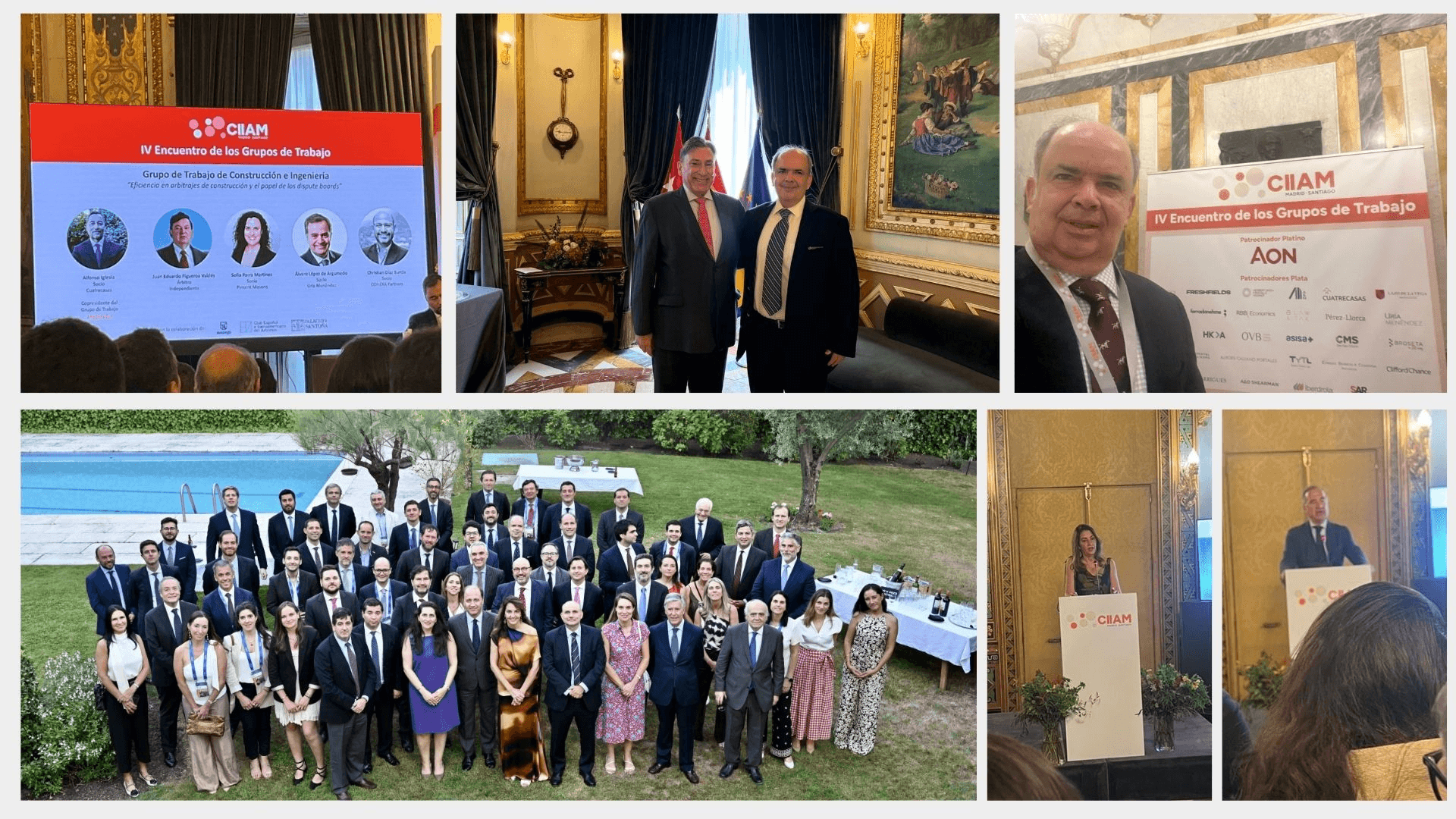
Our partner Rodrigo Nelson participated in the Encuentro Legal Empresarial Madrid 2026, held as part of the activities organised by the International and Ibero-American Arbitration Centre of Madrid (CIIAM) and the Arbitration and Mediation Centre of the Santiago Chamber of Commerce (CAM Santiago), which brought together leading arbitration and dispute resolution professionals from all over Ibero-America.
The activities began on 27 May with a welcome reception led by José María Alonso, President of CIIAM, and Ximena Vial, President of CAM Santiago, who highlighted the importance of strengthening cooperation and the exchange of experiences between the different actors of the Ibero-American arbitration ecosystem.
During the four days of the meeting, Rodrigo actively participated in different panels on litigation and dispute resolution, as well as in the working groups of the specialised groups of Digital Economy, Intellectual Property, Construction and Engineering, Energy and Investment and Arbitration with States, spaces designed to analyse trends, share best practices and discuss the main challenges faced by companies and organisations in an increasingly complex global context.
The agenda also included institutional and networking activities, including a meeting held at the Chilean Embassy in Madrid, which allowed to strengthen links between professionals, arbitrators, academics and representatives of the business sector from different countries in the region.
Rodrigo also had the opportunity to share with partners from different jurisdictions, including Eduardo Benavides, partner at ECIJA Peru and Arturo Guerrero, partner at ECIJA Costa Rica, reaffirming the value of international collaboration and joint work between the firm's offices.
The participation of ECIJA Chile in this meeting reflects the firm's commitment to the development of international arbitration, the exchange of knowledge and the active presence in the main spaces of legal discussion in Latin America, contributing to the strengthening of innovative solutions to the challenges faced by our clients.

Related professionals
LATEST FROM #ECIJA

In Mexico, international arbitration has become a common means of resolving complex disputes relating to investments, long-term contracts and strategic projects.

An article by Héctor Sbert, a partner in the litigation and arbitration department at ECIJA Barcelona, in which he analyses the scope of the recent reforms on corporate transparency and their impact on the regime governing shareholdings.

For years, digital evidence has been incorporated into civil and commercial proceedings as a natural extension of documentary evidence. Screenshots, emails, messaging conversations, attachments, recordings, and images have become a standard part of the evidence.
However, artificial intelligence implies that this approach must be reconsidered. Much of this evidence can no longer be treated as mere documents: they are technically vulnerable evidence, the strength of which depends on its origin, integrity, context, and reliability.

The daily disconnection caused by compulsive mobile phone use not only affects personal relationships: it reveals why cybercriminals are exploiting our biases and routines to carry out increasingly sophisticated scams.

ECIJA, represented by Héctor Sbert, Jesús Lorente Ariza and Xavier Miraball, has contributed as the author firm for the chapter on Spain in "Cryptoassets". Law Over Borders Comparative Guide 2026.

On 19 May 2026, María de Mulder Rougvie, counsel in the Litigation and Arbitration department at ECIJA Barcelona, spoke at one of the world’s leading forums on fraud, insolvency, asset recovery and cross-border enforcement (Fraud, Insolvency, Recovery & Enforcement).
The partner of ECIJA Chile participated in panels, working groups and networking activities together with leading figures in Ibero-American arbitration.

The measure unifies the national procedure with that of several local jurisdictions that already applied similar incentives.

The rise of wearable devices has turned the body into a constant source of highly sensitive data, pressing the principles of the GDPR against large-scale, persistent, and difficult-to-understand data processing.